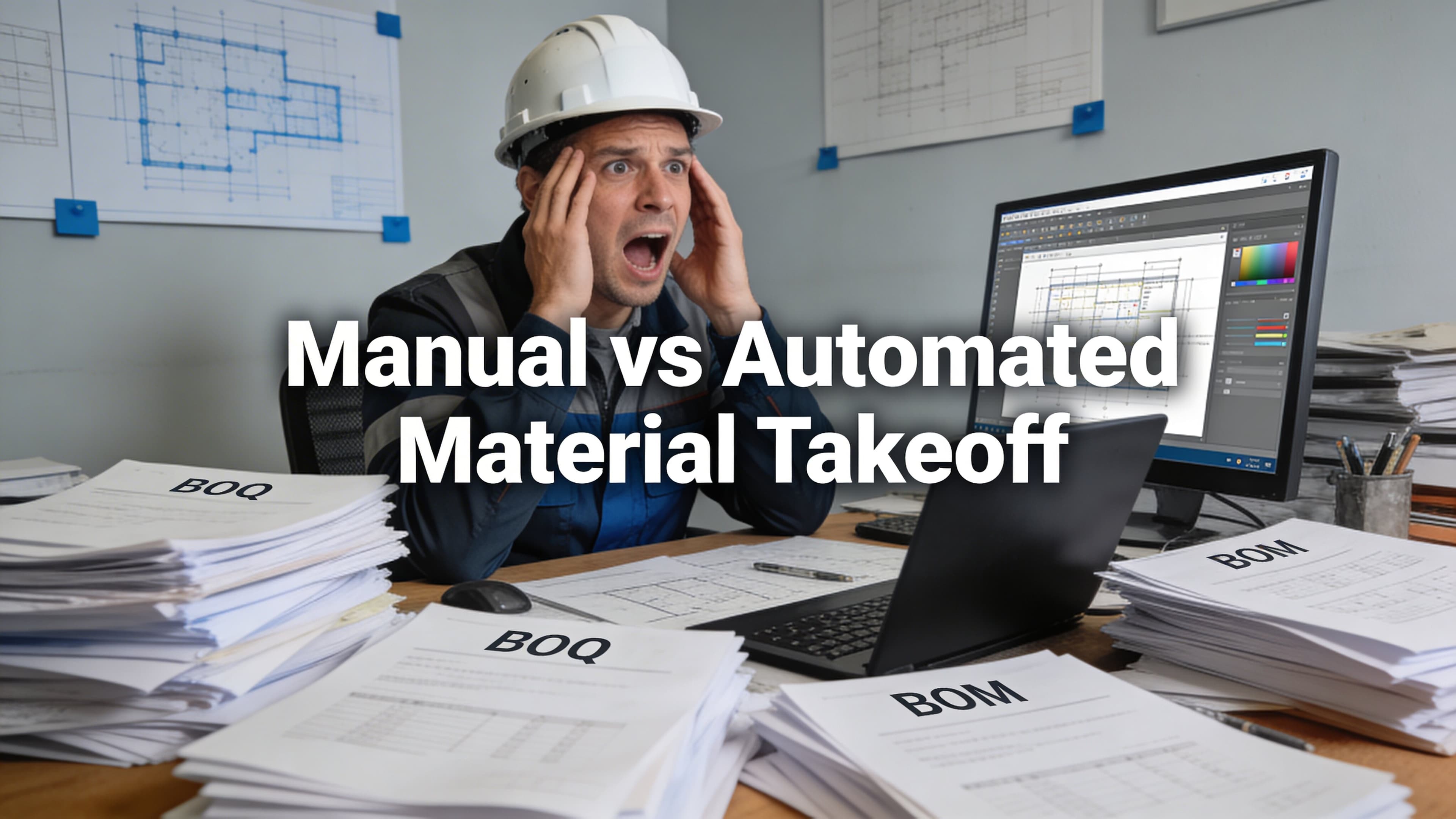
Digital vs Manual Material Takeoff: Accuracy, Speed & Best Practices
Manual vs automated material takeoff is one of the most common debates in construction estimating: is digital takeoff more accurate than manual measurement, or does it mainly save time? This guide compares manual quantity takeoff and automatic / computer-assisted takeoff on accuracy, speed, revision handling, and when each approach still makes sense.
Short answer
Neither method is "always" more accurate by itself—errors come from misreading drawings, wrong scales, and inconsistent rules. Automation usually reduces arithmetic and transcription error and speeds re-measurement when drawings change; expert review still matters for scope and interpretation.
Accurate material quantities remain the foundation of reliable estimation. For decades, teams used printed drawings and spreadsheets; today, digital tools can generate takeoffs faster—with fewer copying mistakes—when configured with clear measurement standards.
What Is a Material Takeoff?
A material takeoff is the process of measuring and calculating material quantities directly from project drawings before cost estimation or procurement begins.
It involves identifying construction elements, measuring dimensions, and converting those measurements into usable quantity data.
For a complete explanation of how material takeoffs work, see the full guide here: material takeoff guide.
How Manual Material Takeoffs Work
Traditional takeoffs are performed by reviewing drawings and calculating quantities manually.
Typical workflow:
- Print or open drawings
- Measure dimensions using scale tools
- Calculate areas and volumes manually
- Enter results into spreadsheets
- Review calculations for errors
This method has been widely used for years and can work effectively for small projects.
Advantages of Manual Takeoffs
- Full control over measurements
- Familiar workflow for experienced estimators
- No dependency on software tools
Limitations
- Time-consuming process
- High risk of calculation mistakes
- Difficult to update when drawings change
- Repetitive manual work
How Automated Material Takeoffs Work
Automated workflows use digital tools to extract and organize quantities directly from drawings.
Instead of manually calculating every measurement, estimators:
- Upload project drawings
- Identify measurement areas digitally
- Generate calculated quantities automatically
- Export structured reports
Automation reduces repetitive calculations and standardizes measurement processes across projects.
Accuracy Comparison: Manual vs Automated
| Factor | Manual Takeoff | Automated Takeoff |
|---|---|---|
| Measurement Speed | Slow | Fast |
| Human Error Risk | High | Reduced |
| Drawing Revisions | Requires recalculation | Easily updated |
| Consistency | Varies by estimator | Standardized |
| Scalability | Limited | Suitable for large projects |
Automation does not remove professional judgment, but it reduces calculation-related errors that commonly occur during manual workflows.
Where Manual Takeoffs Still Make Sense
Manual methods may still be suitable when:
- Projects are very small
- Only rough estimates are required
- Digital drawings are unavailable
- Early feasibility studies are being performed
However, as project complexity increases, manual workflows become harder to maintain.
Why Accuracy Matters in Quantity Reporting
Even small quantity miscalculations can lead to:
- Budget overruns
- Material shortages
- Procurement delays
- Tender pricing inconsistencies
Accurate takeoffs directly influence downstream documents such as Bills of Quantities and Bills of Materials.
Learn how quantities are structured into pricing documents here: Bill of Quantities.
Practical Example
Consider a multi-unit residential project.
A manual estimator may spend several days calculating wall finishes, flooring areas, and concrete volumes. If drawings are revised, much of the work must be repeated.
With automated workflows, updated drawings allow quantities to be recalculated quickly, reducing delays and improving consistency across revisions.
The Shift Toward Digital Estimation
Construction workflows are increasingly moving toward digital quantity reporting because projects demand faster turnaround times and higher accuracy.
Automation helps teams:
- Reduce repetitive calculations
- Maintain standardized reporting
- Respond quickly to design changes
- Improve collaboration between teams
Understanding how estimation documents connect is also important. See the comparison here: BOQ vs BOM vs Material Takeoff comparison.
Conclusion
Manual material takeoffs have long been part of construction estimation, but automated workflows are changing how quantities are calculated and managed. While professional expertise remains essential, automation reduces calculation errors, improves efficiency, and allows teams to handle complex projects with greater confidence.
Choosing the right method depends on project size, complexity, and the level of accuracy required, but modern construction increasingly favors digital quantity reporting for reliable results.
Generate material takeoff reports directly from your drawings with QtyReport. Create accurate reports in minutes.
Get Started Free