What Is a Bill of Quantities (BOQ)? Meaning, Uses & Construction Role
If you are pricing a tender, comparing subcontractor bids, or explaining scope to a client, you will encounter a bill of quantities (BOQ). This guide defines what a BOQ is, how it is used on construction projects, and how it differs from related documents like estimates and bills of materials.
Quick answer: what is a BOQ?
Bill of quantities (BOQ) meaning
A bill of quantities is a structured list of construction work items with measured quantities (and often provisional items and notes), used to obtain comparable prices and manage scope. It translates design information—usually from drawings and specifications—into line items contractors can price consistently.
Bill of quantities definition
A BOQ describes what is to be measured and how much of each item is required, following agreed measurement rules. It does not, by itself, tell you the final cost: that comes from applying rates (price per unit) to each quantity line.
Documents may be called "bills of quantities" or "bill of quantity" depending on region; in practice, teams use BOQ as shorthand in construction and quantity surveying.
For software-assisted workflows that start from drawings, see Bill of Quantities on Quantity Report.
What is a bill of quantities used for?
- Tendering: bidders price the same scope, which makes bid comparison fairer.
- Contract administration: quantities anchor valuations, variations, and interim payments when the contract references the BOQ.
- Planning: aggregated quantities support procurement and programme assumptions.
The exact legal weight of the BOQ depends on your contract form and priority of documents—always align the BOQ with the specification and drawings.
BOQ in construction projects
On site, the BOQ connects the design team's intent to commercial outcomes. Quantity surveyors or estimators derive quantities from construction drawings (plans, sections, schedules) and reconcile them with the project specification.
When drawings change, quantities may change. Modern teams reduce rework by linking measurement to digital drawing versions and clear revision tracking.
BOQ vs estimate vs bill of materials
| Document | Focus |
|---|---|
| Bill of quantities (BOQ) | Measured work items for pricing and contract scope (e.g. m², m³, nr). |
| Cost estimate | Expected cost (rates × quantities ± risk)—may exist before or alongside a formal BOQ. |
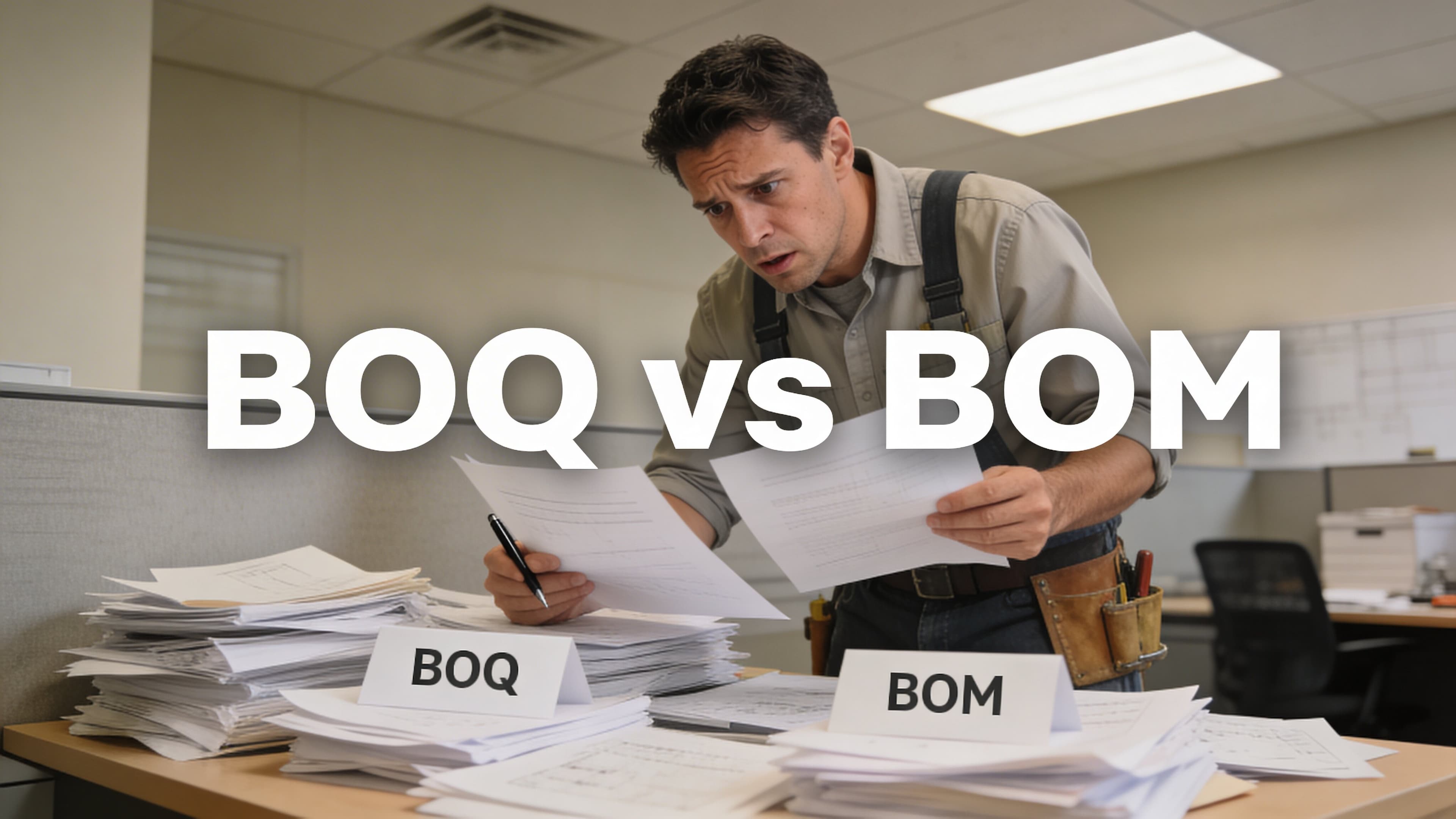
| Bill of materials (BOM) | Materials/components for fabrication or procurement—not the same column structure as a trade BOQ. |
For a deeper comparison of BOQ, BOM, and material takeoff, read BOQ vs BOM vs material takeoff or the focused BOQ vs BOM difference guide.
Typical BOQ structure
Most BOQs group work into sections (by trade, work package, or standard method), then list items with:
- Description referencing spec and drawings
- Unit of measure
- Quantity
- Rate and amount (added at pricing stage)
Large projects may include provisional sums, prime cost sums, and attendance items—your measurement standard (e.g. regional QS practice) defines how these are presented.
Who prepares the BOQ?
Typically quantity surveyors, cost consultants, or specialist estimators prepare BOQs for employers. Contractors may also produce BOQ-style pricing schedules when responding to design-and-build tenders.
Step-by-step measurement from drawings is covered in how to create a BOQ from drawings and bill of quantities preparation.
Summary
A bill of quantities is the bridge between design documents and commercial pricing: it lists measured work so everyone bids and delivers against the same scope. Understanding BOQ meaning in construction helps you read tenders, challenge discrepancies, and align site records with the contract.
Build BOQ-style quantity reports from your drawing sets with QtyReport.
Get Started Free